
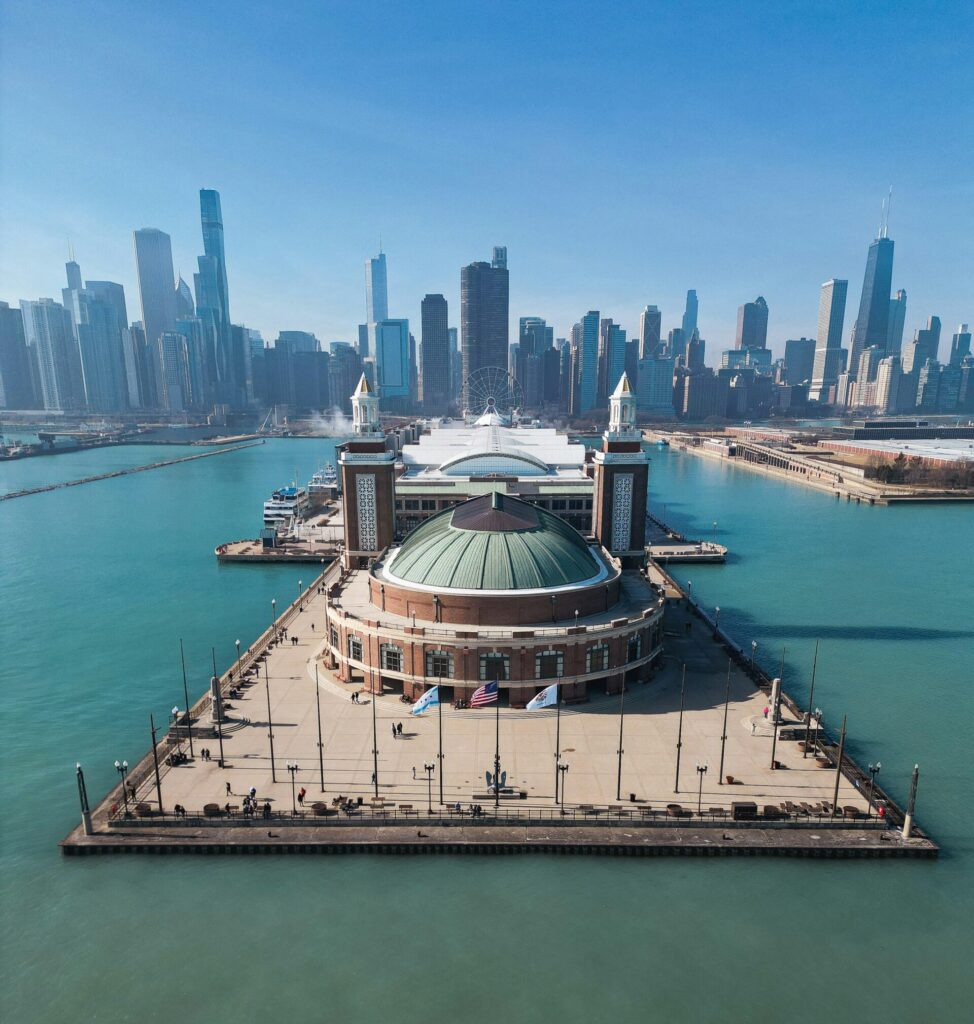
Chicago’s Advantage
08.28.2025
Gensler’s latest City Pulse 2025 Survey backs that up. The data shows Chicagoans rate their city significantly higher than the North American average for overall experience, social connection, and sense of belonging. It’s proof that the elements of daily life that make a city feel alive—ease of movement, opportunities to gather, cultural richness—are deeply embedded in Chicago’s DNA.
“Walkability, connection, and culture aren’t perks. They’re a retention strategy.” – Meghan Webster, Co-Managing Director, Gensler
Chicago is a city people believe in. That belief shows up not just in pride, but in how residents experience and describe their daily lives.
In Gensler’s City Pulse 2025 survey, Chicagoans rated their city 10 percent higher than the North American average for offering a great overall experience, and 12 percent higher as a place to socialize and connect. This is more than a sentiment. It is a signal that the elements of daily life that make a city feel vibrant, like ease of movement, opportunities to gather, and rich cultural energy, are very much alive in Chicago.
In Chicago, walkability ranked as the fourth most important factor in deciding whether to stay, significantly higher than in other North American cities. People are more likely to remain in places where they feel connected to their surroundings, where daily routines can happen on foot, and where neighborhoods offer not just housing, but a full sense of place. Walkable cities support healthier lives, stronger communities, and a deeper sense of belonging—all factors that shape whether people imagine a future for themselves here.
But loving a city is not enough to ensure people will stay. The survey revealed that the strongest predictor of whether someone plans to leave Chicago is whether they feel bored.
Residents are not just evaluating cost or convenience. They are seeking stimulation, engagement, and a sense of progress. The second strongest predictor is whether someone sees Chicago as a good place to grow old, reflecting a desire for long-term connection and support.
Two groups in particular are shaping this conversation. Established residents (those who have lived in the city for six to ten years) are more likely than others to be planning a move. Older adults are more concerned about the city’s future than any other demographic. These insights provide clear signals for how we might shape a stronger, more resilient city. A city where public space, community experience, and accessibility are prioritized across every stage of life.
The business community has a powerful role to play. By investing in walkable, people-centered places; designing for connection and care; and supporting the experiences that make daily life feel rich and meaningful, we can help ensure Chicago remains a city where people don’t just arrive—they stay, grow, and thrive.
By Meghan Webster and Brian Vitale, Co-Office Managing Directors at Gensler
A special thank you to WBC board member company Gensler—and to Meghan Webster and Brian Vitale—for this week’s contribution. Their insights remind us that walkable, people-centered places aren’t abstract ideals; they’re coming to life across Chicago. From the transformation of O’Hare International Airport to the reimagining of the Thompson Center as Google’s Midwest HQ, to the Obama Presidential Center, Project 1901, Navy Pier, and so much more.
Chicago is building the connected, vibrant spaces that will define its future.
For a deeper dive into Chicago’s economic landscape, explore the WBC Research Center’s By the Numbers report—a data-driven snapshot of where our region stands today and the opportunities that lie ahead. From post-pandemic recovery challenges to the strength of an $886 billion regional economy that continues to lead the nation in corporate relocations and expansions, the findings offer both perspective and momentum. Read the report here »»»
Business & Growth
Chicago’s Advantage
09.04.2025
Chicagoland’s schools — from elementary through world-class universities — are one of the region’s greatest assets and a major reason why people and businesses choose to build their futures he
Chicago’s Advantage
08.28.2025
Chicago’s reputation as one of the world’s great cities is no accident. From legendary music festivals and blockbuster events to curated art fairs, farmers markets, world-renowned architecture, ic

Chicago’s Advantage
NEWS
WBC Research Center
08.18.2025
This week, the World Business Chicago Research Center released its latest Chicago Business Bulletin: Chicagoland By the Numbers — a comprehensive, data-driven snapshot of the region’s economy. The

Chicago’s Advantage
07.31.2025
Chicago’s neighborhoods are alive with energy this summer, bursting with music, dance, street festivals, and endless opportunities to try intriguing cuisines or dine alfresco at exciting eateries. W
